Ongoing feedback
Our high-frequency VUCA Feedback tool for pointed and intensive personnel development processes

Our high-frequency VUCA Feedback tool for pointed and intensive personnel development processes
By ongoing feedback we mean an innovative feedback mode in which
Ongoing Feedback aims to provide intensive feedback. Ongoing feedback is particularly useful in addition to (or as a follow-up to) traditional 360° feedback.
This form of continuous and regular formal feedback, which results in more frequent discussions about goals and work performance, meets the changing needs of people in organisations in times of increasing volatility, uncertainty, complexity and ambiguity (VUCA). Managers and employees thus learn to use these regular impulses for personal development.

The Ongoing Feedback from Eva is a typical example of a promising feedback process. A favourable, if not necessary, requirement is that our fictional feedback recipient Eva strives for a change in her own behaviour, but has not yet been able to implement this. Often this intrinsic motivation for change results from a previously conducted 360° feedback. Eva has decided to focus for one year on a certain behaviour pattern that has ruined opportunities for her in the past. Especially for the next career steps, her environment expect her to be more mature in dealing with conflicts. The regular feedbackLOOPS lead to three essential effects:
Eva decided on a total of four feedbackLOOPS over the course of a year, because a high feedback frequency can lead to survey fatigue among the feedback providers, in other words to a certain lack of interest in the feedback process. This should be avoided.
Function description:
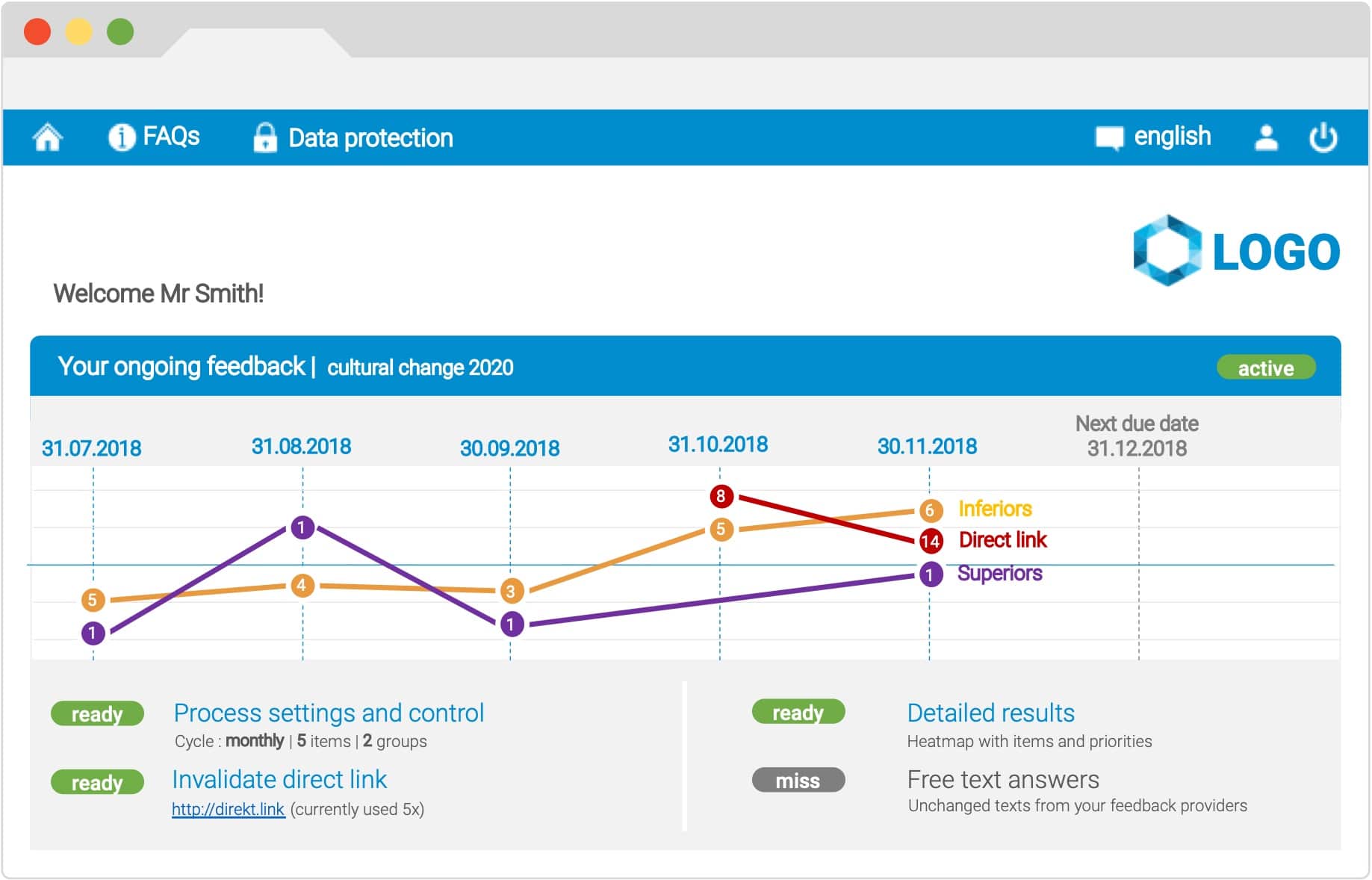
The ongoing feedback can be clearly distinguished from the established 360° feedback by the features listed below.
| Traditional 360° feedback | Ongoing feedback | |
|---|---|---|
| Content | Prescribed contents, but better comparability | More individual questionnaire; own questions can also be formulated |
| Frequency | Mostly annually or every two years | Event related: weekly, monthly or quarterly |
| Initiation | Often centrally by HR department or company management | Decentrally by the manager, a coach or even by the feedback recipients themselves |
| Scope | long | short |
| Technology | online and/or pen & paper | exclusively online |
Furthermore, the ongoing feedback has to be distinguished from other innovative feedback variants:
A detailed examination of the different feedback modes can be found in the review article “Feedback trends in organisations: 360°, Ongoing, Instant, Always-on and Kudo” by Holtmeier, S., & Mertin, I. (2020).
Article overview
 3sixty – Our 360 Degree Feedback “out of the box”